Albert Malet

Albert Malet

1912 – 1986

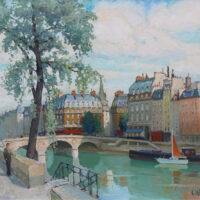
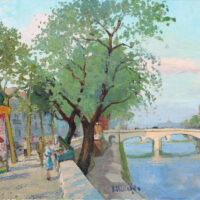
It is now sixteen years since the death of “the last of the Impressionists” as Albert Malet was considered to be by the major art critics of his time.

Born in 1912, at Bosc-le-Hard, near Rouen, Albert Malet was greatly impressed by the work of Jean-Baptiste Corot However, his greatest inspiration to pursue a career in the world of art came from the famous Rouen painter, Robert Antoine Pinchon. A tremendous understanding developed between the two men, which evolved into a great friendship that lasted until Pinchon’s death. Malet became his successor as the head of the prestigious L’École de Rouen.

It is important to note that as a key member of L’École de Rouen, Malet painted regularly with the other leading Rouennais artists of the time such as Narcisse Guilbert, Marcel Couchaux, Pierre Le Trividic, Narcisse Hénocque and Maurice Louvrier. His work also inspired a number of noted poets of the time, namely Philippe Tournaire, Pierre Laurent, Roger Vaccaro and Olivier Costa de Beauregard.

A highly talented man, Malet was also a meteorologist, a botanist, an astronomist and had a great knowledge of precious metals and prehistoric fossils. He held a diploma from L’École Normale, and was Vice-President of the Société des Sciences and Chevalier des Palmes Académiques.

Albert Malet was a member of the Comité des Peintres Normandes and the Société des Artistes Rouennais. The Salon de L’École Française invited him to exhibit at the Palais de Tokyo in Paris. He won a gold medal at the Salon U.F.O.L.E.A. and a bronze in the exhibition for Artistes Français. Malet’s paintings have been shown throughout the major galleries around the world and the President of France offered his work on numerous occasions as a gift to visiting heads of state, including President Ronald Reagan.

Despite his many titles and achievements, Albert Malet remained eternally modest – always encouraging his pupils and admiring the qualities of others. Malet’s sole focus was inspiring young artists to develop and continue the great tradition of L’École de Rouen.
South Florida Web AdvisorsAlbert Malet

Constant Troyon

Constant Troyon

1810 – 1865

Constant Troyon began his career as a porcelain painter. By the late 1830’s he turned his attention to landscape painting, and his first Salon entries were views of Saint-Cloud and Sèvres, near the state porcelain works. These early paintings were characterized by bright colors based on his experience working with porcelain glazes. In 1843, Troyon became friends with Théodore Rousseau and Jules Dupré, and began to frequent Fontainebleau, which would provide him with a new subject for his paintings. In 1846, he was awarded a first-class medal at the Salon.

The turning point in Troyon’s career was in 1847 when he visited the Lowlands. Here he fell under the influence of the two great 17th century Dutch animal painters—Albert Cuyp and Paulus Potter. When he returned to France, he concentrated on animal painting, and the Salon of 1849 saw his first entry devoted to an animal subject. From this point on he was a great success, both critically and financially, and his influence was felt in France, the Lowlands, and Germany. Troyon became the first Barbizon artist to win overall acceptance. Exhibitions of his works were held in London, Manchester, Brussels, Vienna, Antwerp and The Hague. His paintings of animals, rooted in their natural surroundings, are characterized by a perfect balance of color, line and composition.

By the eighteen-fifties Troyon’s reputation was established. He exhibited abroad regularly, and was asked to be a member of the jury for the 1855 World Exhibition. Even his simplest sketches fetched high prices.

Whether painting a cow in a pasture or a pointer in a field, animal and nature co-exist in total harmony when they are recorded by Troyon’s brush. When Constant Troyon died in 1865, his reputation as one of the greatest animal painters of the 19th Century was firmly established.

South Florida Web AdvisorsConstant Troyon

Georges Braque

Georges Braque

1882 – 1963

Georges Braque along with Pablo Picasso developed cubism and the cubist style, and  became one of the major figures of 20th-century art.

Georges Braque was born in Argenteuil-sur-Seine, France. He grew up in Le Havre and trained to be a house painter and decorator like his father and grandfather, but he also studied painting in the evenings at the École des Beaux-Arts in Le Havre from about 1897 to 1899. He apprenticed in Paris under a decorator and was awarded his certificate in 1901. The following year he attended the Academie Hummer and painted there until 1904. It was here that he met Marie Laurencin and Francis Picabia.

His earliest works were impressionistic, however he became impressed by the bold style of work exhibited by the Fauves in 1905 and soon adopted a Fauvist style. Braque worked most closely with the artists Raoul Dufy and Othon Friesz, who shared Braque’s hometown of Le Havre, to develop a somewhat more subdued Fauvist style. In 1906, Braque traveled with Friesz to L’Estaque, Antwerp, and home to Le Havre to paint.

In 1907, Georges Braque successfully exhibited works in the Fauve style in the Salon des Indépendants. The same year, Georges Braque’s style began a slow evolution as he came under the strong influence of Paul Cézanne, who died in 1906, and whose works were widely exhibited in Paris.

In his works of 1908 to 1913 Braque’s paintings began to evidence his new interest in geometry and simultaneous perspective. He conducted an intense study of the effects of light and perspective and the technical means that painters use to represent these effects, appearing to question the most standard of artistic conventions. In his village scenes, for example, Braque frequently reduced an architectural structure to a geometric form approximating a cube, yet rendered its shading so that it looked both flat and three-dimensional. In this way Braque called attention to the very nature of visual illusion and artistic representation.

Beginning in 1909, Georges Braque began to work closely with Pablo Picasso who had been developing a similar approach to painting. Both artists produced paintings of neutralized color and complex patterns of faceted form, now called Analytic Cubism. In 1912, they began to experiment with collage and papier collé. Their productive collaboration continued until 1914 when Braque enlisted in the French Army, leaving Paris to fight in the First World War.

Georges Braque was severely wounded in the War, and resumed his artistic career alone in 1917, whereupon he moved away from the harsher abstraction of cubism and developed a more personal style, characterized by brilliant color and textured surfaces and, following his move to the Normandy seacoast, the reappearance of the human figure. He painted many still lifes during this time, maintaining his emphasis on structure. During his recovery he formed a close relationship with the famous cubist artist Juan Gris. He continued to work throughout the remainder of his life, producing a considerable number of distinguished paintings, graphics, and sculptures, all imbued with a pervasive contemplative quality. He died August 31, 1963, in Paris.

South Florida Web AdvisorsGeorges Braque

Jean Carzou

Jean Carzou

1907 – 2000

Internationally renowned, Jean Carzou mastered a number of mediums throughout his career, often opting to work on textured, unusual surfaces rather than plain canvas.  An extremely prolific and well-respected artist, Carzou produced dramatic works in these mediums on a variety of subjects.  Carzou’s works adorned Paris opera houses and captured the passion of saints on chapel walls. Few artists have museums devoted solely to their work; however Carzou has two with a third opening soon. Musee Carzou opened in 1986 in Vence, in the south of France and the other is in Manosque, France.  The third will open in Yerevan, Armenia.

Born Karnik Zouloumian on January 1st, 1907 in Syria to an Armenian family, Carzou later created his name from the first syllables of his first name and surname. Becoming a world traveler at an early age, Carzou was educated in Cairo, Egypt before moving to Paris at the age of 17 to study art and architecture in earnest. In 1925, he graduated from the Paris School of Architecture. Despite changing his name to the more Parisian “Jean Carzou”, the artist kept close ties to his Armenian heritage, and was ever mindful of his people’s all too frequent political struggles and sufferings. This superb artist brought Armenian contemporary art to its highest level. Politics ultimately became one of the young artist’s first means of support, when he abandoned the pursuit of architecture for the fine arts, and resorted to working as a street artist, doing caricatures and portraits to support himself and his studies. The caricatures became popular, and Carzou soon found his sketches of politicians and public figures published in Paris newspapers.

In 1939, Carzou had his first one-man show in Paris and he took the City of Lights by storm. It did not take him long to become famous. He was innovative, visionary and romantic.  Through his line drawings and engravings he became well known as an illustrator for some of the 20th century’s most revered writers, including Hemingway, Albert Camus, Ionesco and Rimbaud. One of the artist’s master works, completed in his 80s, was the Apocalypse of Saint Joan in the Chapel at Manosque in Vaucluse, France, which depicted not merely the passion of the saint and national hero, but the ravages of war.

Carzou’s diverse talents were employed often by some of the most celebrated stages in Paris, and throughout the 1950s his set and costume designs appeared at the Comedie Francais as well as Paris Opera. Carzou also enjoyed sharing his art as an educator with the Paris Institute of Fine Arts, and he saw the establishment of the Carzou Foundation in 1991, at the age of 84.

Over the course of his long career, Carzou received many honors. He was a member of France’s Academie des Beaux-arts and decorated with the National Order of Merit. Other honors included three Hallmark Prizes for painting, Japan’s Education Prize, Brussells’ Grand Prize of Europe, and the Grand Prize of the Ile de France. In 1976 Carzou became the first living artist to have his work appear on a French postage stamp.

Jean Carzou, who remained active in his work and the management of his collections which now have permanent homes in America, Great Britain, Egypt, Japan and his adopted homeland, France, died of old age in Perigeaux, France on August 12, 2000.  Jean Carzou was preceded in death by his wife, Nané Carzou in 1978, and is survived by their only child, writer Jean-Marie Carzou.

South Florida Web AdvisorsJean Carzou

Leon Richet

Leon Richet

1847 – 1907

Apprentice of Baker and Diaz, Léon Richet sometimes appears audacious in his manner of treating the light of the sky and the reflections in the water.  He debuted at the Salon in 1869 with Bouleaux sur les hauteurs de la Plaine blanche, forêt de Fontainebleau, and Mare dans la gorge aux Loups.  He also paints in Normandy, in Picardie, and in the Bourbonnais, where he shows himself faithful, but sometimes more lyric, to the principles of the school of Barbizon.

Léon Richet was born in Solesmes in 1847.  He was a pupil of Diaz, Lefebvre, and Boulanger.  He began his career at the Salon in 1869.  Richet’s success included a citation in 1885, a second place medal in 1888, and a second class medal in 1901.  Classified among the landscape painters who were inspired by leaders of the Barbizon school, Richet holds it in an honorable place.  Museums in Leeds, Montreal and Nice are among those that display his work.  Richet died in Fontainebleau, March 26, 1907.

South Florida Web AdvisorsLeon Richet

Nicola Simbari

Nicola Simbari

1927 – 2012

In Calabria there are records going back hundreds of years of “Simbari” as a family name, yet Nicola Simbari is the first of that long line to be an artist.

Nicola Simbari’s Family Life

His father was an architect and builder; in his mother’s family, the legal profession is a tradition, and most of its members are lawyers. Simbari has two brothers and two sisters, none of whom are artists. One cannot explain the emergence of a highly gifted illustrator, stage designer, muralist, painter and sculptor from such ancestry except by conceding that genius is a mystery for which there is no explanation.

At a very early age, Nicola Simbari was exposed to artistic influences. He was born in San Lucido, a fishing village in Calabria, but when he was three years old his father moved the family to Rome, where he was employed as an architect and builder in the Vatican museums, and by the time he was seven he knew and loved the Michelangelo frescoes in the Sistine Chapel.

Simbari’s Developing Art Career

The Sistine frescoes are a monumental blend of architecture and painting, and during the fours years Simbari spent at the Accademia delle Belle Arti in Rome, he studied both painting and architecture, excelling in the latter to such degree that he was made a member of the Accademia’s faculty in architecture. But painting was his real interest and soon he relinquished the post in order to concentrate on painting.

Simbari’s first one-man show of paintings was in Rome in 1953, and in that same year he won an award for best stage design for a musical, “Tarantella Napoletana” produced in Rome. In 1954 the Italian State awarded him a gold medal for a poster entered in a national competition. Three years later he had his first one-man show in London and in 1958 he won the coveted honor of being commissioned to paint the murals for the Italian Pavilion at the World’s Fair in Brussels.

Success & Recognition as an Artist

Since his first one-man show in Rome in 1953, many important private collectors both in Europe and America have acquired Simbari’s paintings. They form part of the collection of the Virginia Museum of Fine Arts, the Liberty Company in London, and the Christian Dior Collection in France. In the United States his work has become widely known through the frequent exhibitions presented by Wally Findlay Galleries.

Nicola Simbari’s Artistic Style & Technique

As a painter Simbari initially was interested in mainly the avant-garde movement. Braque was his first god, followed by Miró, but gradually he became involved in an effort to tell a story with his paintings, so he changed to a more introverted approach, meanwhile developing an admiration for Gauguin, Van Gogh and de Staël.

To those who know his work today, it may come as a surprise to learn that his early work, resulting from the more introverted approach, consisted mainly of very small paintings done in egg tempera and entirely with brushes, somewhat in the manner of Vermeer, whom he still greatly admires. In these small paintings the colors were somber and much ochre and gray were employed.

Nicola Simbari gradually found himself freed from influences, developed the style now recognized as Simbaresco. He defined himself as a figurative artist who went through Abstract Expressionism, Geometric Abstraction and a number of other styles of painting, but who had always been a figurative painter because his greatest interest was in people.

Just as Nicola Simbari’s style in painting was his own, so his technique in painting was his own. He was meticulous and exacting in the choice of materials: he accepted only the finest canvas and prepared it with care; he had his colors ground by a family in northern Italy who had been engaged in this work for three hundred years; he mixed his own pigment.

He continuously developed new graduations of color or new colors, and exulted when he had succeeded in adding a more brilliant one to the range of his palette. When he used a brush, it was only to create the background of the painting, which was then completed with palette knives of which he had about twenty-five sizes ranging from very tiny ones to huge ones.

1957    First one-man show in London

1958    Exhibition Gallery Obelisco, Rome

1959    Exhibitions in London and New York

1960    First one-man show in Palm Beach

1961     Findlay Galleries in Palm Beach, Los Angeles, San Francisco, London, Philadelphia, St. Louis, and Chicago

1962    Second one-man show at Wally Findlay Galleries in Palm Beach, and second one-man show in Chicago

1963    Several one-man shows at Wally Findlay Galleries in New York, Chicago, and Palm Beach

1969    Selected Paintings, Wally Findlay Galleries, New York

1970    Creates two sculptures in bronze

1971    Selected Paintings, Wally Findlay Galleries, Paris

1971    Selected Paintings, Wally Findlay Galleries, Palm Beach

 1972    Selected Paintings, Wally Findlay Galleries, New York and Beverly Hills

1973    Selected Paintings, Wally Findlay Galleries, Paris and Retrospective, Chicago

1976    Exhibition Crazy Horse Saloon Wally Findlay Galleries, Paris

1977    Exhibition Le Cirque Wally Findlay Galleries, New York and Palm Beach

1978    Exhibition Le Cirque Wally Findlay Galleries, Paris

1979    Exhibition The Mediterranean Wally Findlay Galleries, Paris

 1981    Exhibition Paris Wally Findlay Galleries, Paris

 1983    Exhibition The Grand Prize, Hotel de Paris, Monte Carlo

1984-87 Exhibitions Germany, Japan, and the United States

1988    Exhibition Soar with Simbari Wally Findlay Galleries, Palm Beach

1988    Exhibition, Un lointain regard Wally Findlay Galleries, Paris

1989    Thirteen Cityscapes and The Caribbean,  Wally Findlay Galleries, New York

1990    Exhibition, The Caribbean Wally Findlay Galleries, Palm Beach

1990    Exhibition, Soar with Simbari Wally Findlay Galleries, New York

1991    Selected Paintings, Wally Findlay Galleries, New York

1992    Exhibition, Simbari and his World, Wally Findlay Galleries, Palm Beach

1992    Selected Paintings, Wally Findlay Galleries, Chicago

1993   Simbari-Favorite Paintings Findlay Galleries, New York and Palm Beach

 1997    Exhibition Simbari Three simultaneous exhibitions Wally Findlay Galleries, New York, Palm Beach, and Chicago

2001   The Retrospective, 50 Years of Achievement” Wally Findlay Galleries, New York, Palm Beach, and Chicago

2005    Selected Paintings, Wally Findlay Galleries, New York

2005    Selected Paintings, Wally Findlay Galleries, Palm Beach

2006    Selected Paintings, Wally Findlay Galleries, Palm Beach

2008    Nicola Simbari, Wally Findlay Galleries, Palm Beach

2009    Nicola Simbari, Wally Findlay Galleries, Palm Beach

2011    Seven Decades, Nicola Simbari, Wally Findlay Galleries, Palm Beach

2015    Exhibition, Retrospective Collection by the Pallet Knife Master, Wally Findlay Galleries, Palm Beach

2018    Simbari, Findlay Galleries, Palm Beach

South Florida Web AdvisorsNicola Simbari

Rene Sautin

Rene Sautin

1881 – 1968

Rene Sautin, born in Monfort-sur-Risle in 1881.  He entered the Ecole Beaux Arts, Rouen, studying painting under P. Zacharie. Then in Paris he studied at the Ferrier Studio, where he learned from Albert Lebourg, who was born in the same village.  He entered Le Salon des Independants with Signac and Luce.

He was married in 1910 to Marthe, they settled in Andelys in 1911, making friends with the  Pissarro sons (Lucien and Paulemile), Signac, Luce, Derain, Guillaumin, Lebasque, Bigot, Ge-nez came back to Andelys to paint the Seine riverbanks.

Born from his Normandie earth, Rene Sautin was essentially a landscape artist.  Around 1923 he left the impressionist fold, for fauvism, calmly with thought.

The painter found equilibrium in the smallest of expressions from 1925, and waited for the feeling of totality in the 1950s.  He is one of the —- artists from Normandie who composed his landscapes in such a personal way, yet strong, and a certain violence in dominating himself, and his will.  A strong sensitivity.

A proud man, distinguished, very cultural, he suffered much, to have not been understood in his time, and he regretted that isolation.  “My life was often hard and difficult.”

South Florida Web AdvisorsRene Sautin

Alexander Calder

Alexander Calder

1898 – 1976

Sculptor and kinetic artist Alexander Calder was born in 1898 in Philadelphia, Pennsylvania, the son of Alexander Stirling Calder and grandson of Alexander Milne Calder, both well know sculptors. He was encouraged to sculpt and construct things in his own workshop at an early age. In 1919 he graduated from Stevens Institute of Technology with a degree in mechanical engineering, and after holding several jobs, he decided to take classes at the Art Students League in New York City. During his student years he did line drawings for the National Police Gazette. Calder began exhibiting his paintings at this time, but also focused on drawing, illustration, and wood and wire sculpture.

In June, 1926 Calder moved to Paris. He attended classes at the Academie de la Grande Chaumiere and he created his performance piece, Cirque Calder, a complex and unique body of art. The assemblage included diminutive performers, animals, and props fashioned from wire, leather, cloth, and other found materials. Cirque Calder was designed to be manipulated manually by Calder. Every piece was small enough to be packed into a large trunk, enabling the artist to carry it with him and hold performances anywhere. Its first performance was held in Paris for an audience of friends and peers, and soon Calder was presenting the circus in both Paris and New York to much success. Calder’s renderings of his circus often lasted about two hours and were quite elaborate. Indeed, the Cirque Calder predated performance art by forty years.

Alexander Calder befriended many influential artists, including Joan Miro, Fernand Leger, Marcel Duchamp, and Yves Tanguy. He was invited to join Abstraction-Création, an influential group of artists including Arp, Mondrian, and Hélion with whom he had become friendly.

In 1930 Calder met the Dutch painter Piet Mondrian and visited his studio, an event that made him suddenly aware of the modern movement in painting and that influenced his work in the direction of the abstract. In the winter of 1931–32 he began to make motor-driven sculptures consisting of various geometric shapes. The name mobile was given to them by Marcel Duchamp. Movement gave each of these sculptures a continually changing composition. Calder also constructed sets for ballets by both Martha Graham and Eric Satie during the 1930s, and continued to give Cirque Calder performances.

In 1931 Calder married Louisa Cushing James, and after their marriage the Calders traveled continually, not only between France and the United States but also to South America and Asia. In 1933, Calder and Louisa left France and returned to the United States, where they purchased an old farmhouse in Roxbury, Connecticut. Calder converted an icehouse attached to the main house into a studio for himself. Their first daughter, Sandra, was born in 1935, and a second daughter, Mary, followed in 1939.

Because metal was in short supply during the war years, Calder turned increasingly to wood as a sculptural medium. Working in wood resulted in yet another original form of sculpture, works called constellations by Sweeney and Duchamp. With their carved wood elements anchored by wire, the constellations were so called because they suggested the cosmos, though Calder did not intend that they represent anything in particular. The Pierre Matisse Gallery in New York held an exhibition of these works in the spring of 1943.  His association with Matisse ended shortly thereafter and he took up the Buchholz Gallery/Curt Valentin as his New York representation.

The forties and fifties were a remarkably productive period for Calder. In 1939  the first retrospective of his work was exhibited at the George Walter Vincent Smith Gallery in Springfield, Massachusetts. A second, major retrospective was exhibited at the Museum of Modern Art in New York just a few years later, in 1943.

In 1945, Alexander Calder made a series of small-scale works; in keeping with his economy, many were made from scraps of metal trimmed while making larger pieces. While visiting Calder’s studio about this time, Duchamp was intrigued by these small works. Inspired by the idea that the works could be easily dismantled, mailed to Europe, and re-assembled for an exhibition, he planned a Calder show at Galerie Louis Carré in Paris. This important show was held the following year and Jean-Paul Sartre wrote his famous essay on Calder’s mobiles for the exhibition catalogue.

In 1949, Calder constructed his largest mobile to date, International Mobile, for the Philadelphia Museum of Art’s Third International Exhibition of Sculpture. Galerie Maeght in Paris also held a Calder show in 1950, and subsequently became Calder’s exclusive Parisian dealer. His association with Galerie Maeght lasted twenty-six years, until his death in 1976. After his New York dealer Curt Valentin died unexpectedly in 1954, Calder selected the Perls Gallery in New York as his new American dealer, and this alliance also lasted until the end of his life.

Calder concentrated his efforts primarily on large-scale commissioned works in his later years. As the range and breadth of his various projects and commissions indicate, Calder’s artistic talents were renowned worldwide by the 1960s. A retrospective of his work opened at the Guggenheim Museum in New York in 1964. Five years later, the Fondation Maeght, in Saint-Paul-de-Vence, France, held its own Alexander Calder retrospective. In 1966, Calder, together with his son-in-law Jean Davidson, published a well-received autobiography. Additionally, both of Calder’s dealers, Galerie Maeght in Paris and the Perls Gallery in New York, averaged about one Calder show each per year.

In 1976, he attended the opening of yet another retrospective of his work, Calder’s Universe, at the Whitney Museum of American Art in New York. Just a few weeks later, Alexander Calder died at the age of seventy-eight, ending the most prolific and innovative artistic career of the twentieth century.

South Florida Web AdvisorsAlexander Calder

Constantin Kluge

Constantin Kluge

1912 – 2003

Constantin Kluge was born in Riga, Latvia, on January 29, 1912. His parents were Russian, his father a graduate of the Polytechnic Institute of Riga and his mother a Professor of Literature. In 1917 the Bolshevik Revolution and the ensuing Civil War completely uprooted the Kluge family, forcing them to continuously move east for the next three years. In 1920, when Constantin was only 8 years old, his family settled in Manchuria, where the young Kluge learned to speak Mandarin.

Life in Manchuria was short-lived, though, and in 1925 the Kluge family moved again, this time to the French concession of Shanghai. Constantin finished high school in Shanghai, and at the youthful age of seventeen he was already very active member of the Shanghai Art Club. He had been exposed to art throughout his childhood, being taught to handle a brush by his Chinese teacher, and constantly being surrounded by a Chinese respect for beauty. His parents, however, believed that art was not a lucrative or dependable career for Constantin to pursue. So, in 1931, Kluge moved to Paris to study architecture at L’Ecole des Beaux-Arts, abandoning his artistic pursuits. He graduated in 1937 with the title of French Government Architect.

Studying architecture could not quash Kluge’s desire to paint, however, and his years surrounded by the quaint, characteristic scenes of Paris strongly inspired him. So, after graduating, Kluge delayed his return to Shanghai, choosing instead to remain in Paris. He spent the following six months pursuing his dream, painting Parisian scenes all day.

Kluge eventually returned to China, intending to practice his profession of architecture and forget painting, but his friends persuaded him to exhibit his paintings nonetheless. The exhibitions were a resounding success, convincing Kluge once and for all that he could support himself with his art. For a while, he continued to work in Hong Kong as an architect, painting in his spare time. But in 1950 Kluge left China for good, returning to Paris and beginning his career as a full-time artist.

At this point Kluge was already a mature and successful painter, so it was no surprise that he won an award and considerable attention at the Paris Salon in 1951, his first salon. Many more awards followed, including the Madaille d’Argent, the Raymond Perreau prize, and, in 1962, the Gold Medal of the Salon. He was even named a Chevalier de la Legion d’Honneur by the French Ministry of Culture in 1991.

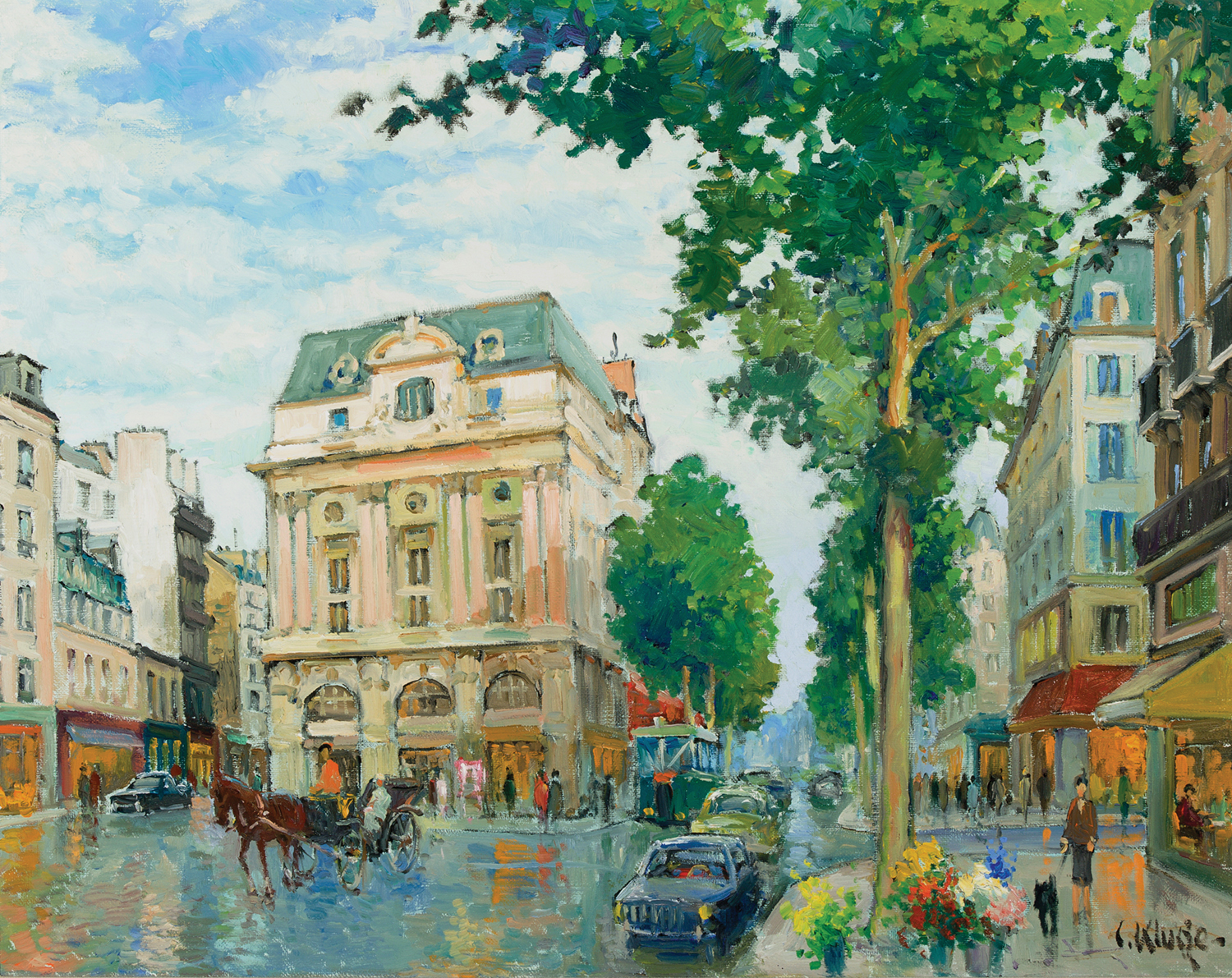
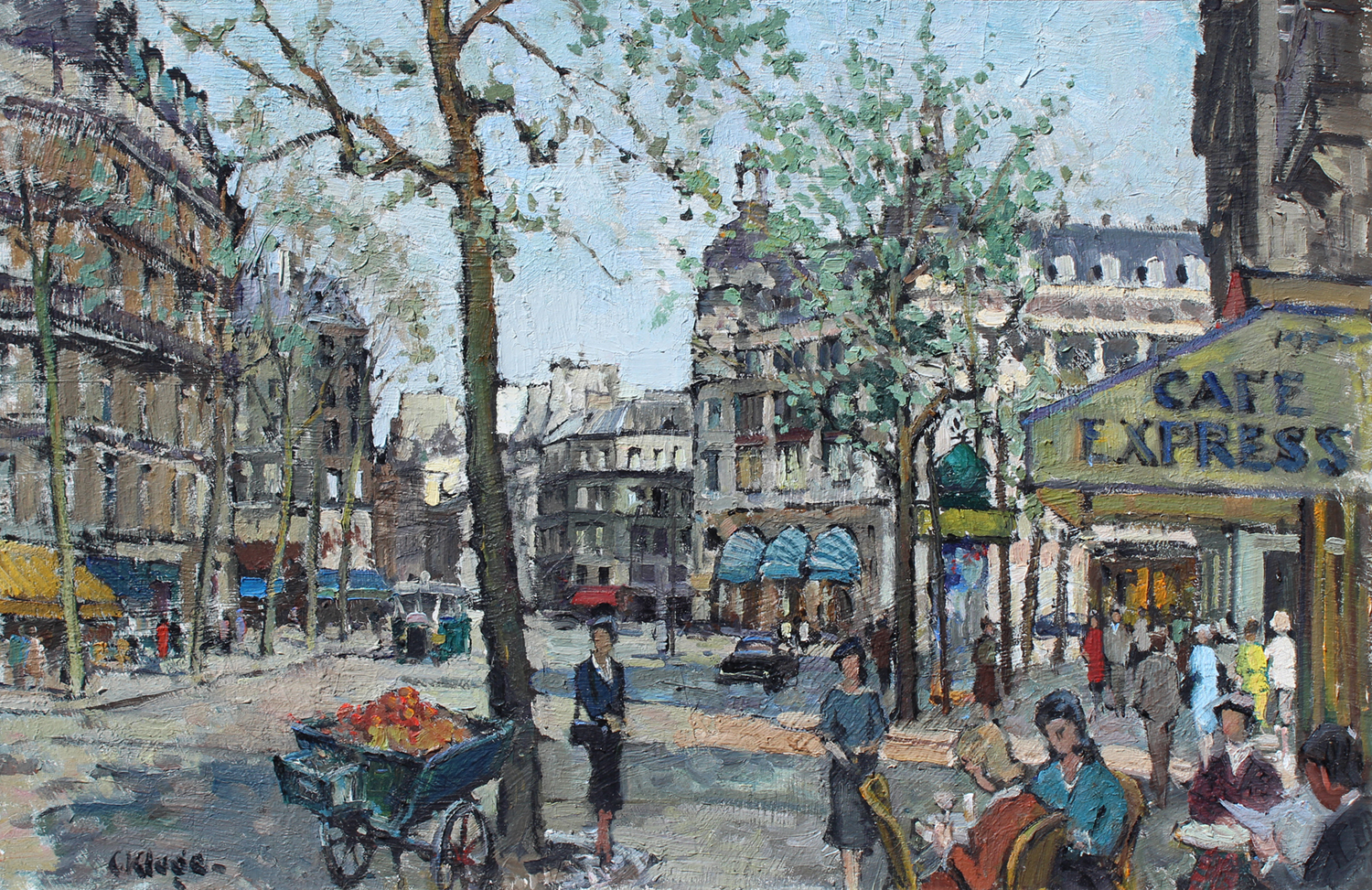
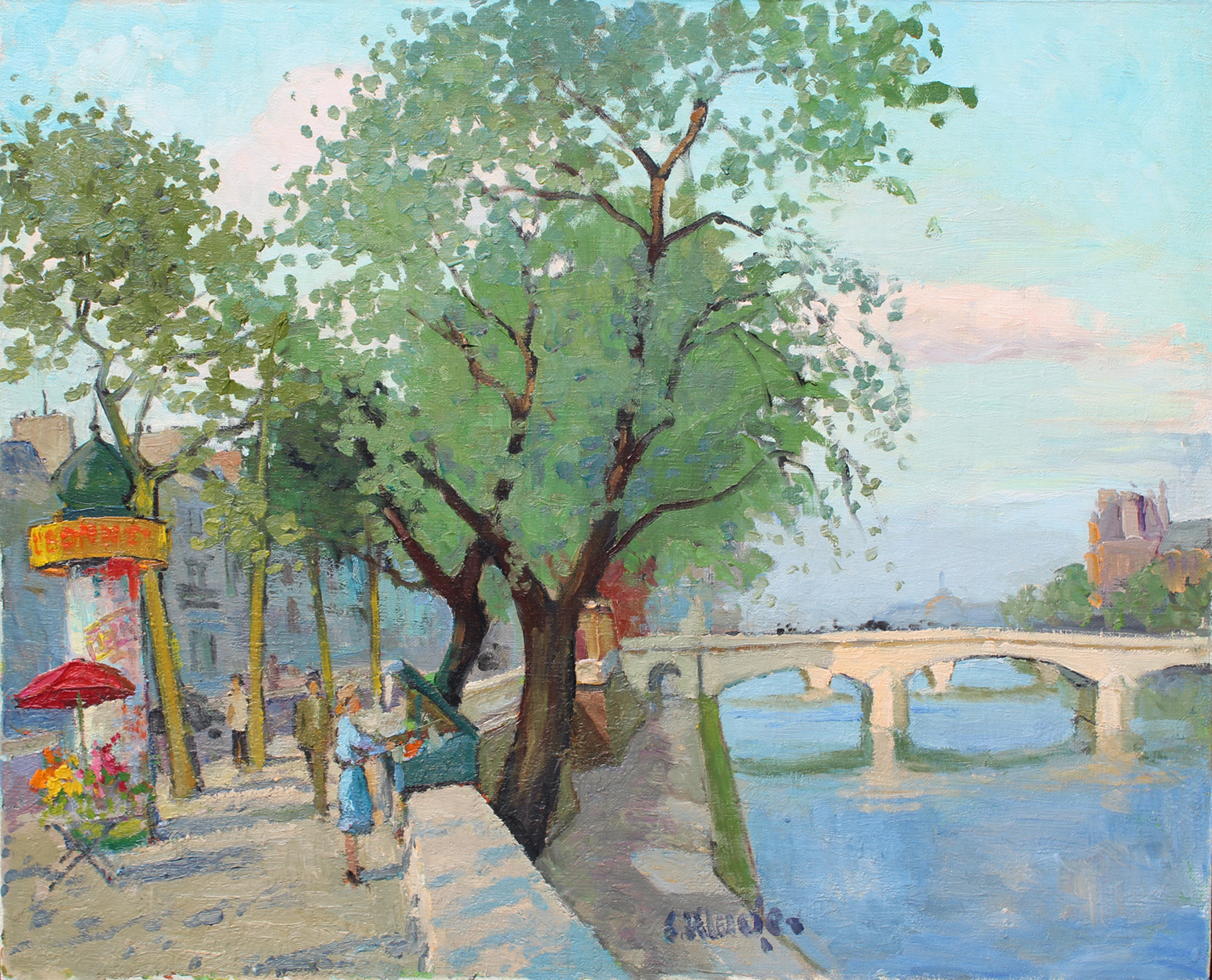
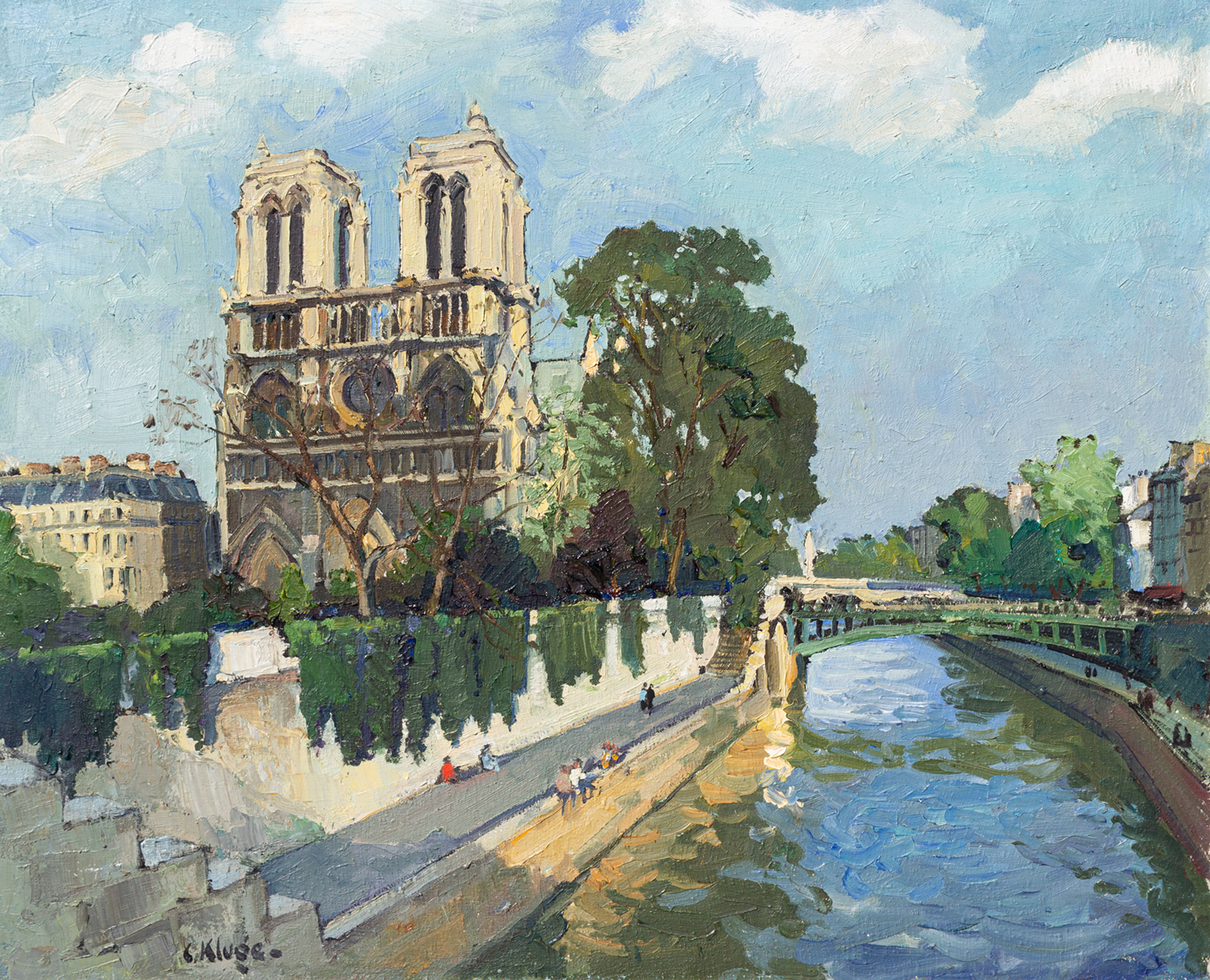
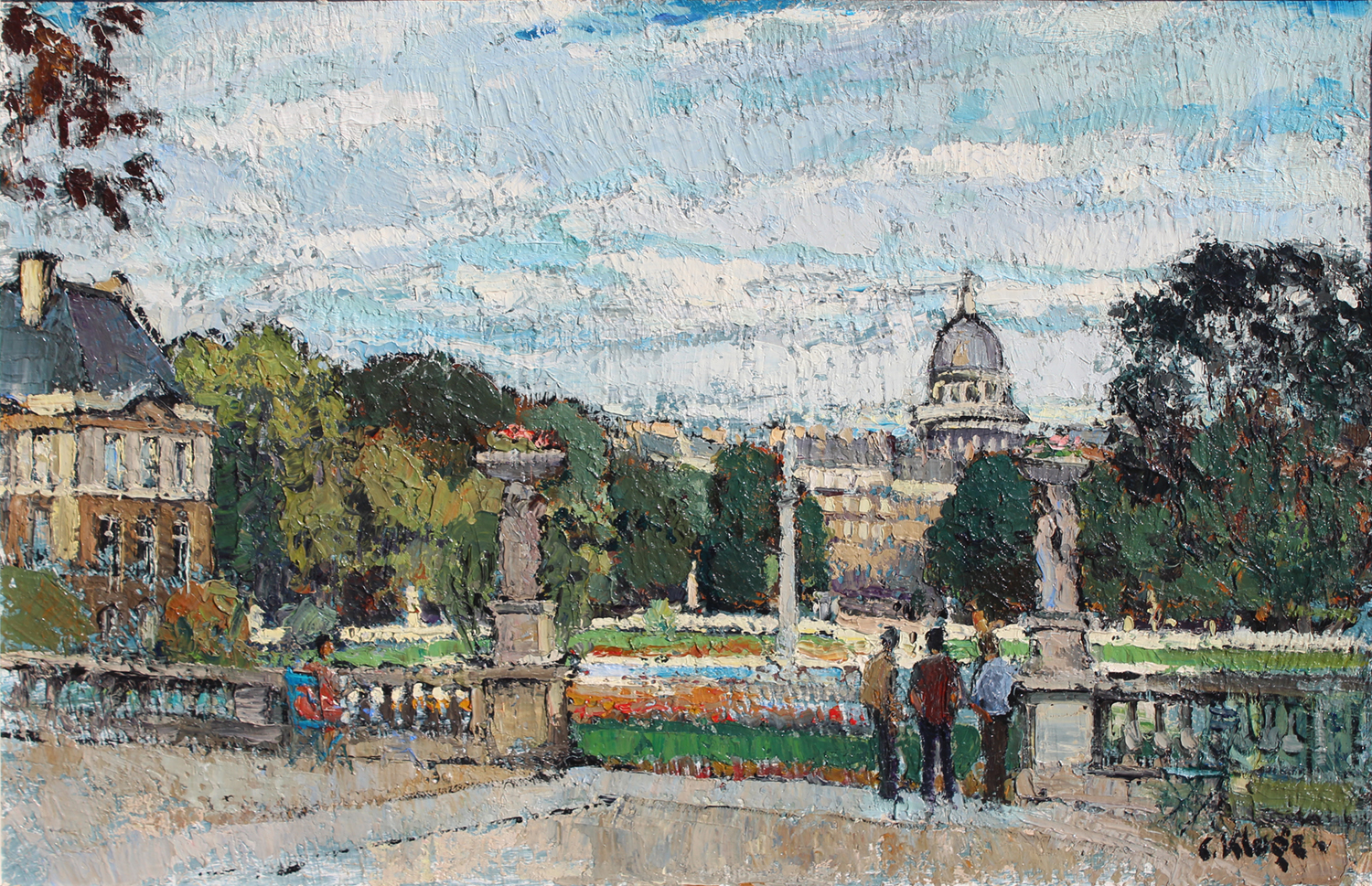
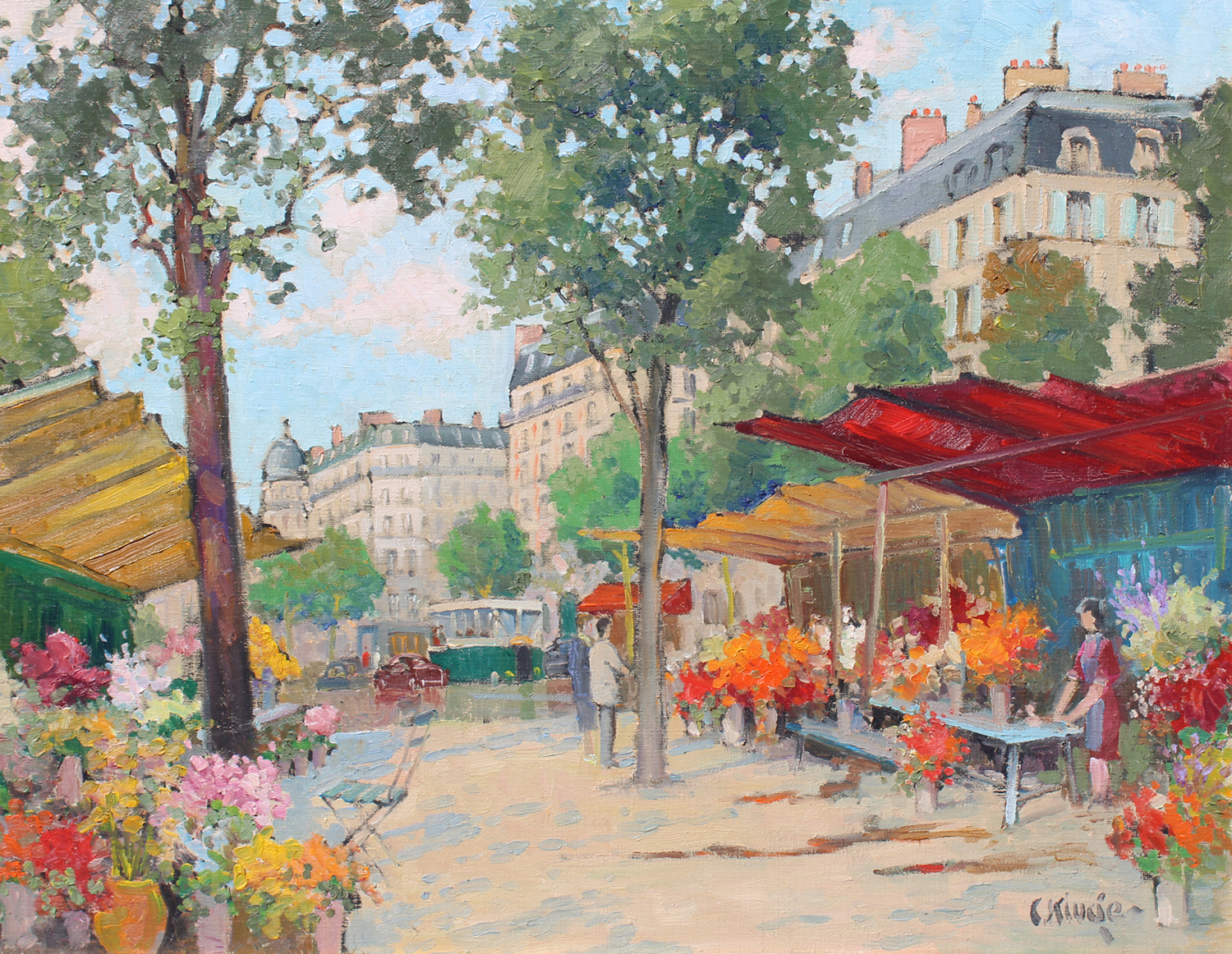
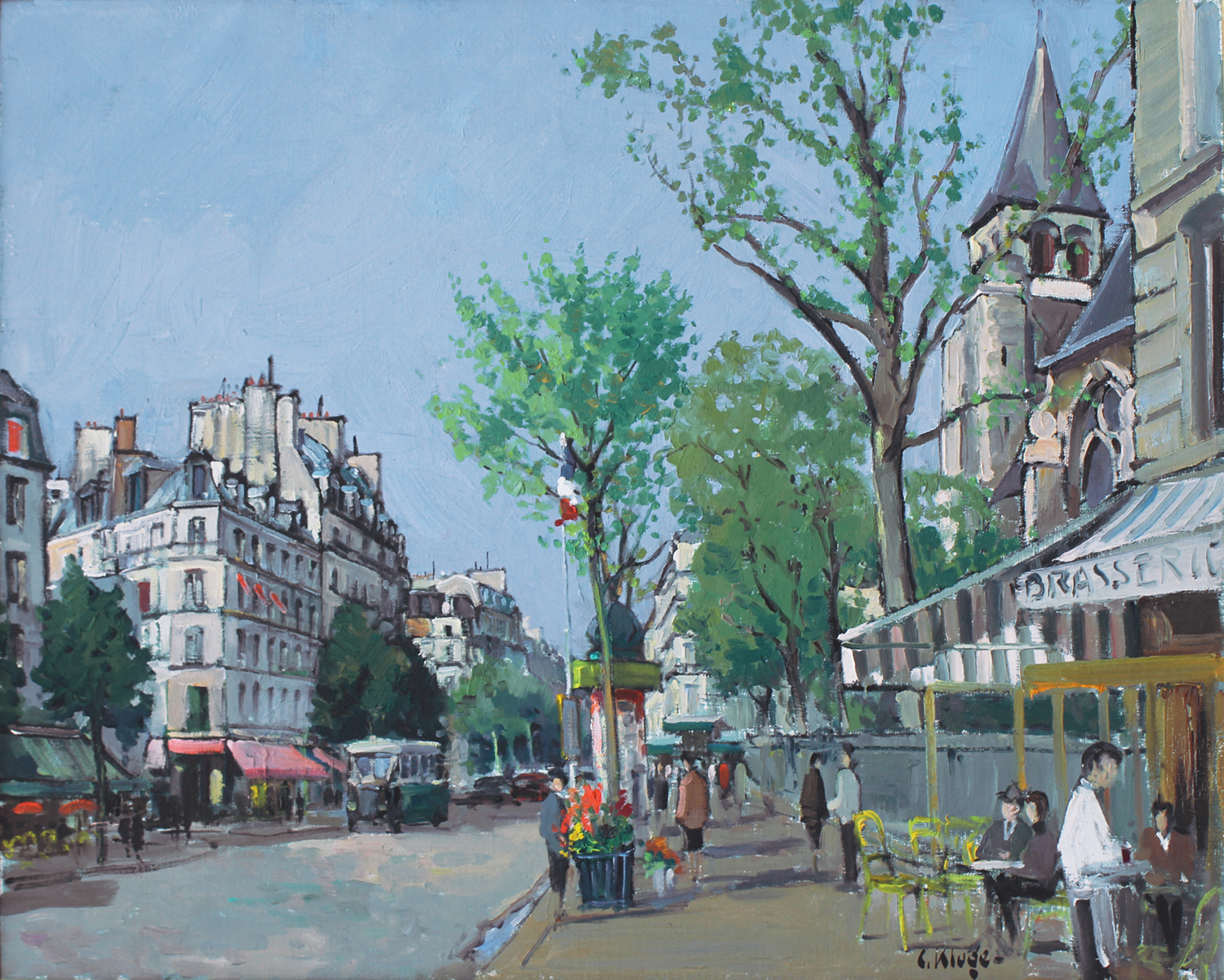
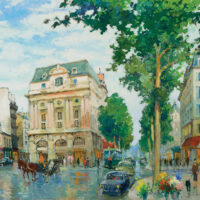
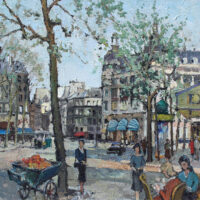
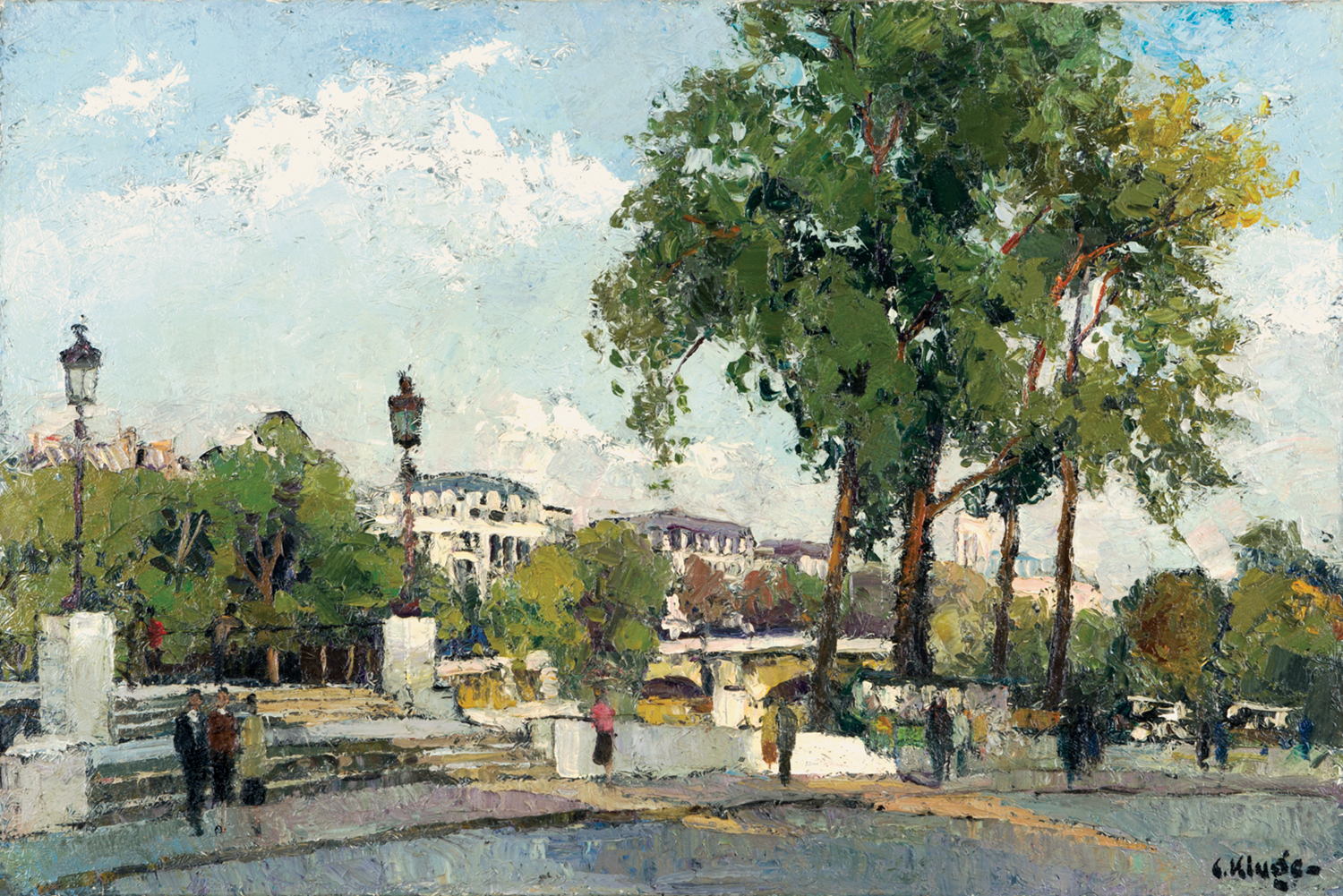
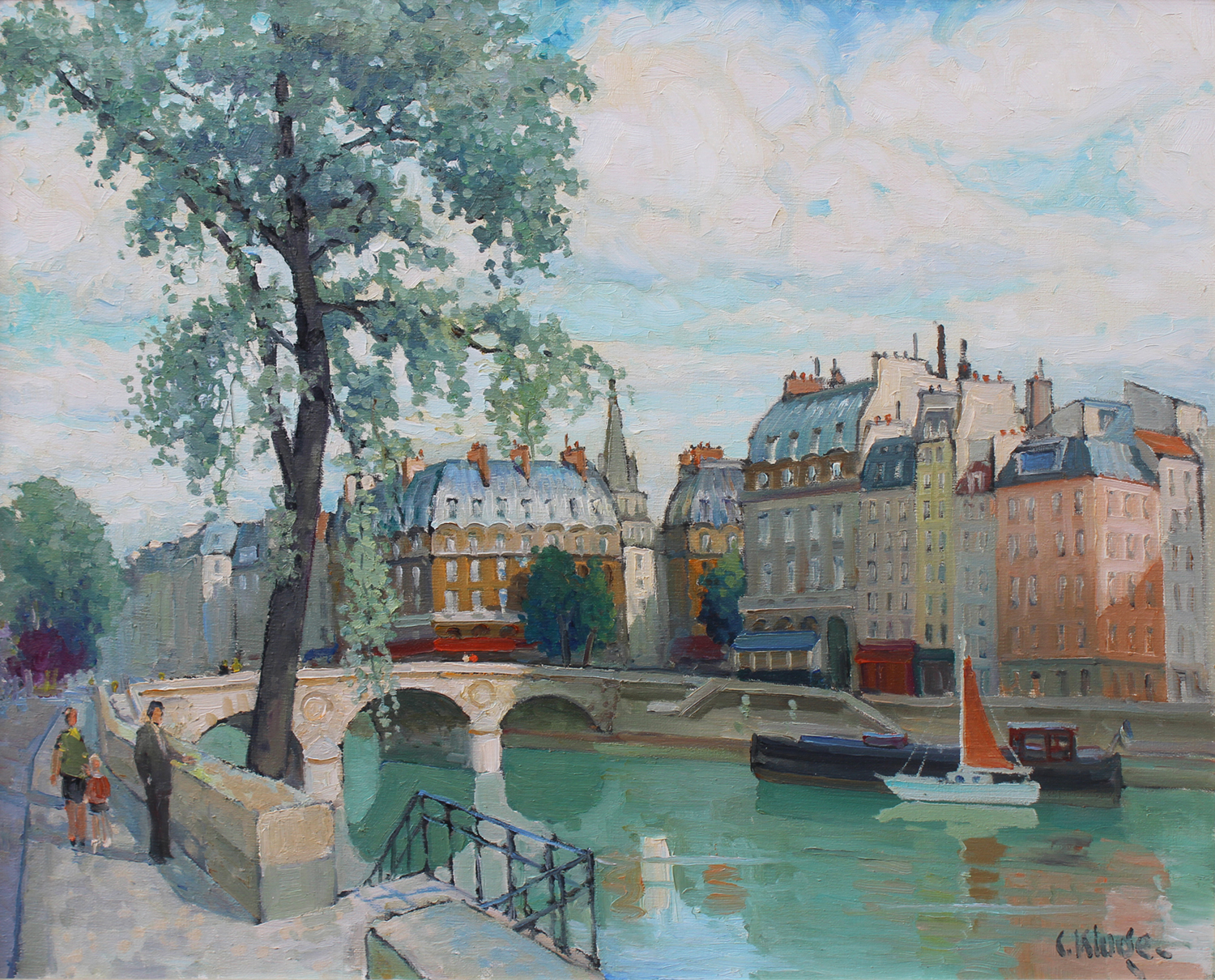
In Kluge’s work, we can see his adoration for the city of Paris. His buildings are rendered not only with the realism and precision of an architect, but with the affection and happiness of a man fulfilling his artistic dream. His firm drawing and well-constructed forms are bathed in an atmosphere of subtle colors. Indeed, every painting is like a love letter to the small, daily scenes of Parisian life. French art critics title Constantin Kluge’s work ‘poetic realism.’ He enjoyed painting and communicated that joy to the beholder.

1951 Salon des Artistes Français, Constantin Kluge, Paris, France

1961 Salon des Artistes Français, Constantin Kluge, Paris, France

1961 Wally Findlay Galleries Exhibitions, Constantin Kluge, New York, Chicago, Los Angeles

1962 Salon des Artistes Français, Constantin Kluge, Paris, France

1992  Musée Antoine Vivenel Exhibition, Constantin Kluge, Compiègne, France

South Florida Web AdvisorsConstantin Kluge

Georges Chauvel

Georges Chauvel

1886 – 1962

Georges Chauvel was a French sculptor born in Elbeuf and studied at the l’ecole des Beaux-Arts.  He was a Chevalier de la Legion d’Honneur which is the highest accolade a French citizen can receive.  He was considered at the time a modernist who expressed himself through his figurative work. He created works depicting mythology, fables and people at leisure.  His career as a sculptor took off after the First World War, he created numerous war memorials like (Somme), carried out in 1920, which represents a woman (crowned with bay leaves) with a dying soldier at her feet.

He exhibited at the famous Salon des Independents in 1919,  and one of his sculptures (naked female walking) can be admired in Le Jardin de Reuilly, a public garden in front of the city hall in Paris.  His work can also be found in the Museums of Lausanne (museum canton. des Beaux-Arts); Paris (Museum National d’Art Moderne); Saint Etienne (Museum d’Art et d’Industrie); etc.  After 1945, he restored the statues in the Park of Versailles.  He is buried in the cemetery of the Val-Saint-Germain (the Essonne).

South Florida Web AdvisorsGeorges Chauvel