Exhibition
A World of Their Own
Findlay Galleries Palm Beach
An exhibition of naïf painting featuring Henri Maïk, Gustavo Novoa, Orville Bulman, Annette Ollivary, and Helena Adamoff, among others.
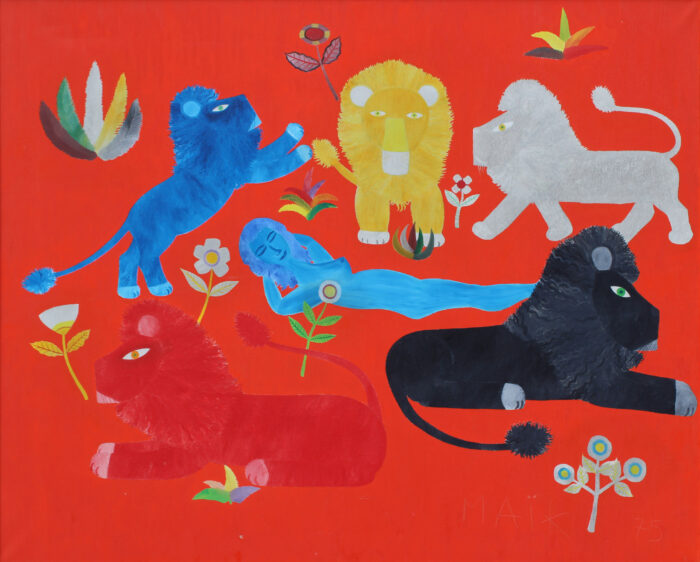
In 1964, Wally Findlay Galleries presented Henri Maïk’s first American exhibition in Palm Beach. Maïk knew what a quiet painting could do for a room full of color. He would place a few paintings in black and white and others in deep blue among his large, brilliantly colored canvases. Six decades later, that interplay is one of the pleasures of A World of Their Own, where Maïk’s paintings share the gallery with works by our other renowned naïf painters, Gustavo Novoa, Orville Bulman, Annette Ollivary, Helena Adamoff, amongst others.
The journey begins with Maïk’s Dormir en Afrique—a blue figure sleeps among lions on a field of undefinable red. In La mare aux animaux, the blue pond is a focal point from which a variety of animals and plants blossom into space. Maïk varied his surfaces throughout his career. A 1973 account in the Palm Beach Daily News compared the raised pigment in some of his paintings to “heavy embroidery or crewel work.” In others, the paint looks as though it has been combed, exposing traces of the color beneath. Since Maïk designed textiles, it is no surprise one can see a weaver’s eye in the way an animal’s markings or the shape of a leaf can carry a pattern across a canvas.
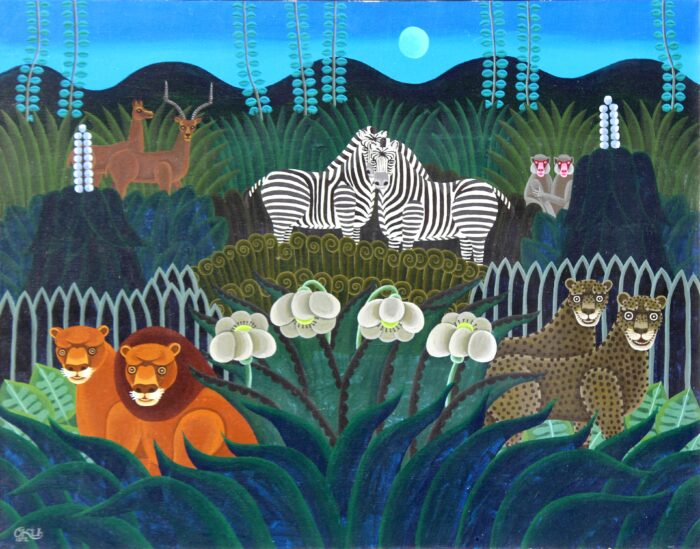
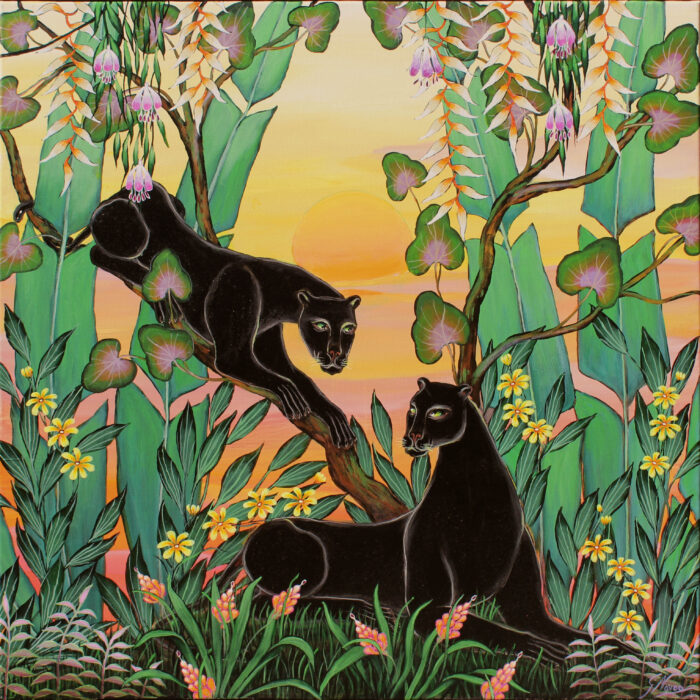
Findlay Galleries began representing Gustavo Novoa in 1971, when the animals that had entered his paintings in the late sixties were becoming his principal subjects. In his jungles, predator and prey can rest beside each other, and animals from different continents can share the same shade. In Zebra Lake, the zebras’ stripes recur in the water, drawing the separate groups together across the still surface. Even his most improbable gatherings have a social order of their own. Novoa’s animals carry themselves with elegance, and their moods and personalities become familiar to collectors around the world.
Read more
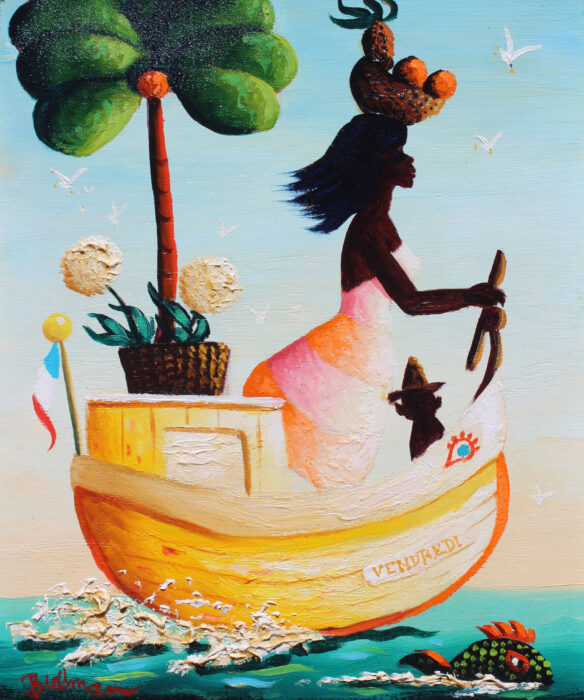
Orville Bulman’s paintings find the vitality of a community in its daily journeys, in the boats that carry people across the water and the homes they build beside it. The carved wooden trim on Haitian houses caught his eye in photographs, and he made seven paintings from those photographs before his first visit in 1952. In Le Barque Vendredi, a woman balances fruit on her head aboard a little yellow boat that also has room for a palm tree. In Pele Mele, a gentleman in a top hat sits above the deck, and two red roosters command nearly as much attention as he does. The yellow hulls and turquoise water give both paintings a buoyant harmony of color. Eleanor Jewett, writing in the Chicago Tribune in 1955, caught the spirit of his humor when she spoke of the “delicious mischief, minus malice” in Bulman’s paintings.
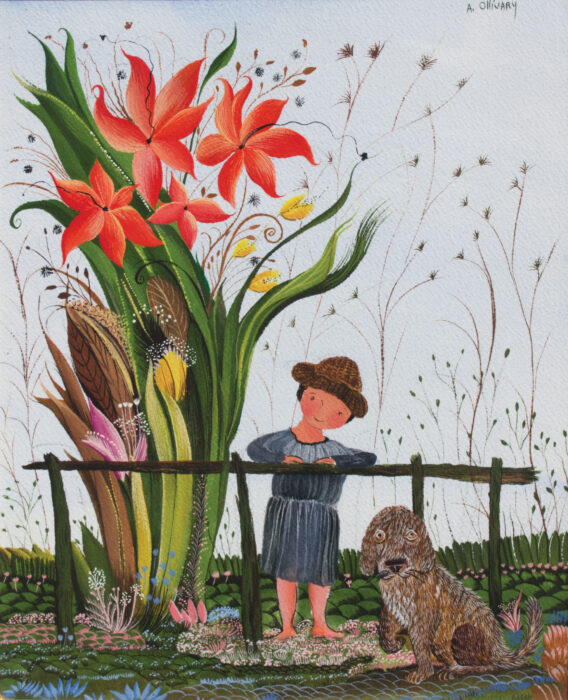
In Annette Ollivary’s paintings, the world grows quiet enough for the smallest creature to hold our attention. The animals and countryside she knew during childhood holidays on her family’s farm in Burgundy stayed with her, as did the discipline of her training at the Académie Julian in Paris. In Petite fermière, a girl leans on a fence with a dog beside her, and the red flowers tower over them both. It has the scale of a child’s recollection, where a flower can be the largest thing in an afternoon. A painting could take Ollivary months to finish, and one can see that patience in the spacing of the stems and the air she leaves around them.
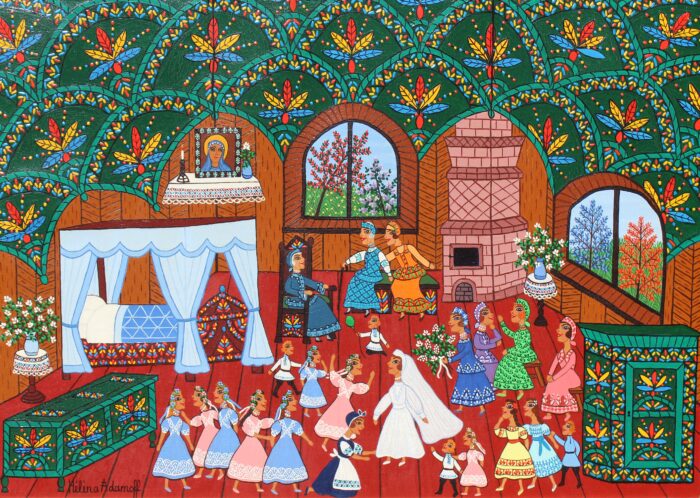
Helena Adamoff gives village life a precise pictorial order. In Le jour de mariage, the bride’s white dress draws the eye into a room where pattern extends from the painted furniture to the ceiling. In Réserve privée, snow gives each figure and animal its own space, so the eye can follow small episodes as they unfold across the landscape. Born in Moscow, Adamoff settled in Paris as a teenager and drew on memories of Russia in her work. The clarity with which she distributes a story across the surface has an affinity with the Russian lubok, the popular illustrated prints that often took the routines and rituals of everyday life as their subject.
Findlay Galleries began exhibiting naïf and primitive painting in Chicago in 1931, with works by Henri Rousseau and Camille Bombois among its early selections. In the decades that followed, the gallery devoted its resources to painters working in a field that much of the art world still regarded as a minor genre. Over decades of representation, Findlay exhibited Henri Maïk and Gustavo Novoa at its galleries in Chicago, Palm Beach, New York and Paris and presented Maïk’s paintings at its Tokyo location. Through successive exhibitions, Maïk, Novoa, and Annette Ollivary gave our collectors a sense of how far three painters of very different temperaments could take the tradition.
We invite you to see their work together in A World of Their Own at our Palm Beach gallery, at 165 Worth Avenue. The first glance may take in the vivid color and the clarity of a scene we seem to know already. A longer look reveals the wit, tenderness, and precision with which each artist makes an imagined world feel enticingly close.
Henri Maïk
Available Work
Rencontre
Henri Maïk
Available Work
Le Barque Vendredi
Orville Bulman
Available Work
Jungle
Shigeo Okumura
Available Work
Sunset arrangement
Gustavo Novoa
Available Work
Petite fermière
Annette Ollivary
Available Work
Sunset arrangement
Gustavo Novoa